
Our work on Differentiable Digital Twin of Distributed Link Scheduling presented at Asilomar 2025
Published:
A Differentiable Digital Twin of Distributed Link Scheduling for Contention-Aware Networking
(Zhongyuan Zhao†, Yujun Ming†, Kevin Chan, Ananthram Swami, Santiago Segarra)
†Equal contribution
Presented at the Asilomar Conference on Signals, Systems, and Computers, Pacific Grove, CA, October 2025.
- Preprint https://arxiv.org/abs/2512.10874
- Source code https://github.com/JoieMing/luby-ndt/
We presented our latest work on building an analytical and differentiable digital twin of distributed medium access control (MAC) based on randomized contention — a mechanism widely used in Wi-Fi, mobile ad-hoc networks, wireless mesh networks, and in emerging 6G scenarios such as wireless backhaul and spectrum sharing.
The purpose of this digital twin is to enable gradient-based optimization for wireless networking.
While network flow optimization is well understood in wired networks — for example through efficient algorithms for minimum-cost flow — it becomes far more complex in wireless systems, where links contend for transmission in a shared medium.
Here, link capacity and cost depend not only on the physical-layer data rate but also on the traffic loads and activity of other links across the network.
Traditional methods rely heavily on trial-and-error for routing and on packet-level simulation for network analysis, both of which are slow and provide limited analytical insight.
Our analytical digital twin models contention behavior as a graph-based function, capturing the resulting effective link capacity through link scheduling duty cycles. This enables fast prediction of congestion across the network, as illustrated below.
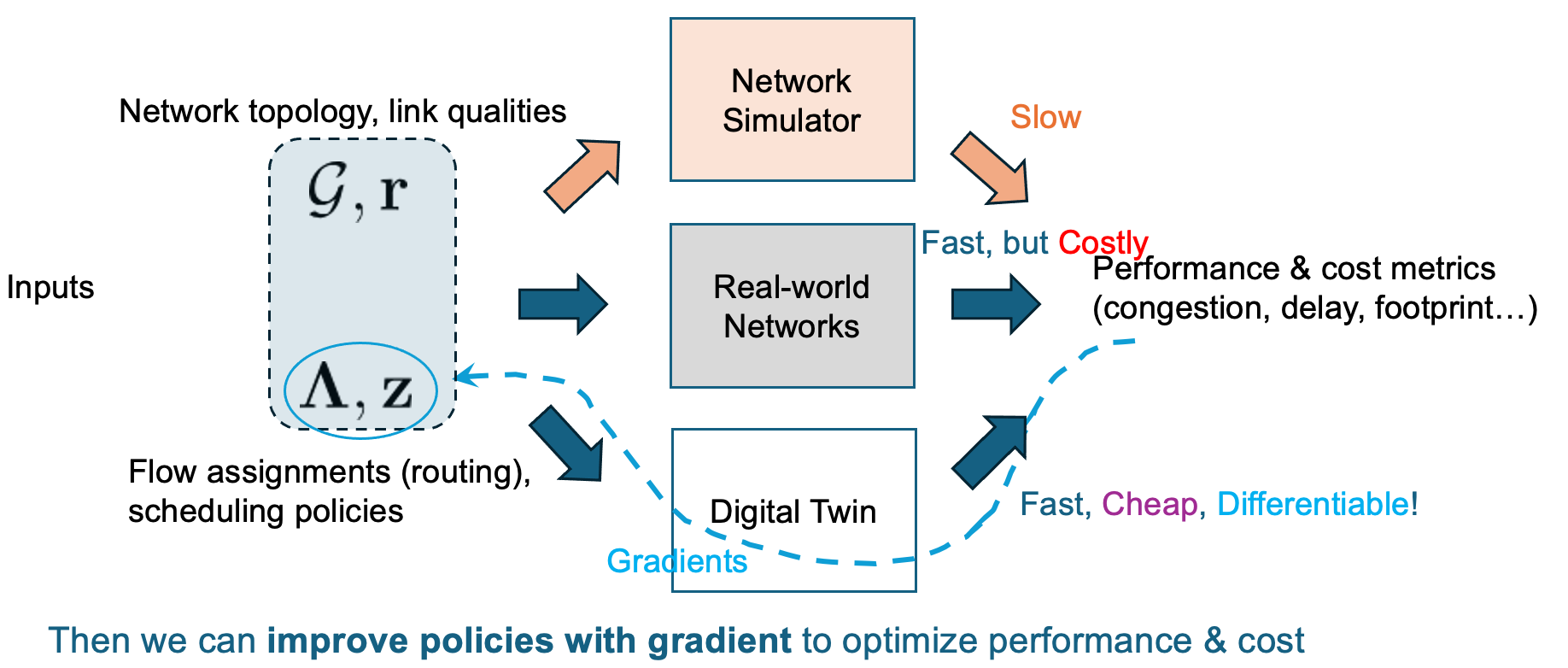
Figure 1. The differentiable digital twin models link contention and effective capacity to forecast congestion.
The proposed model runs over 1000× faster than simulation (reducing runtime from minutes to tens of milliseconds) and allows us to apply gradient-based optimization to improve link scheduling priorities, routing, and load-balancing decisions — effectively mitigating congestion and expanding network capacity.
Moreover, it can be implemented in a fully distributed manner, making it suitable for integration into next-generation network protocols.
In the example below, congestion is mitigated by optimizing the link-level contention aggressiveness in a network of 50 transceivers and 8 flows, while keeping all routing paths fixed.
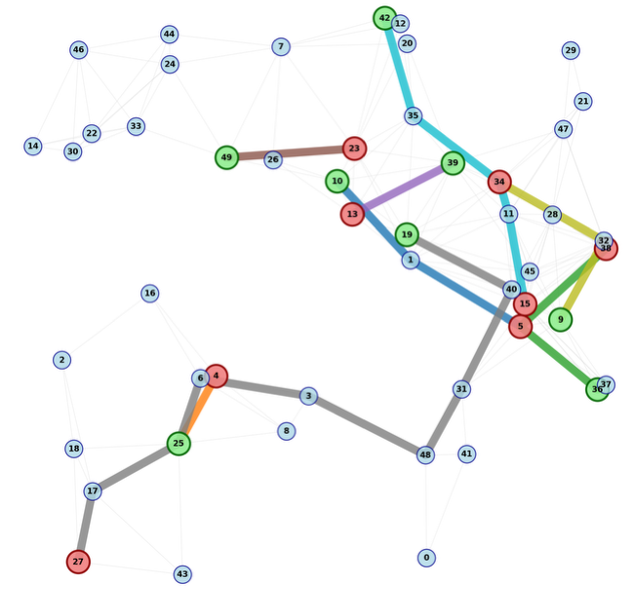
Figure 2. A test instance with 8 flows on a network of 50 nodes.
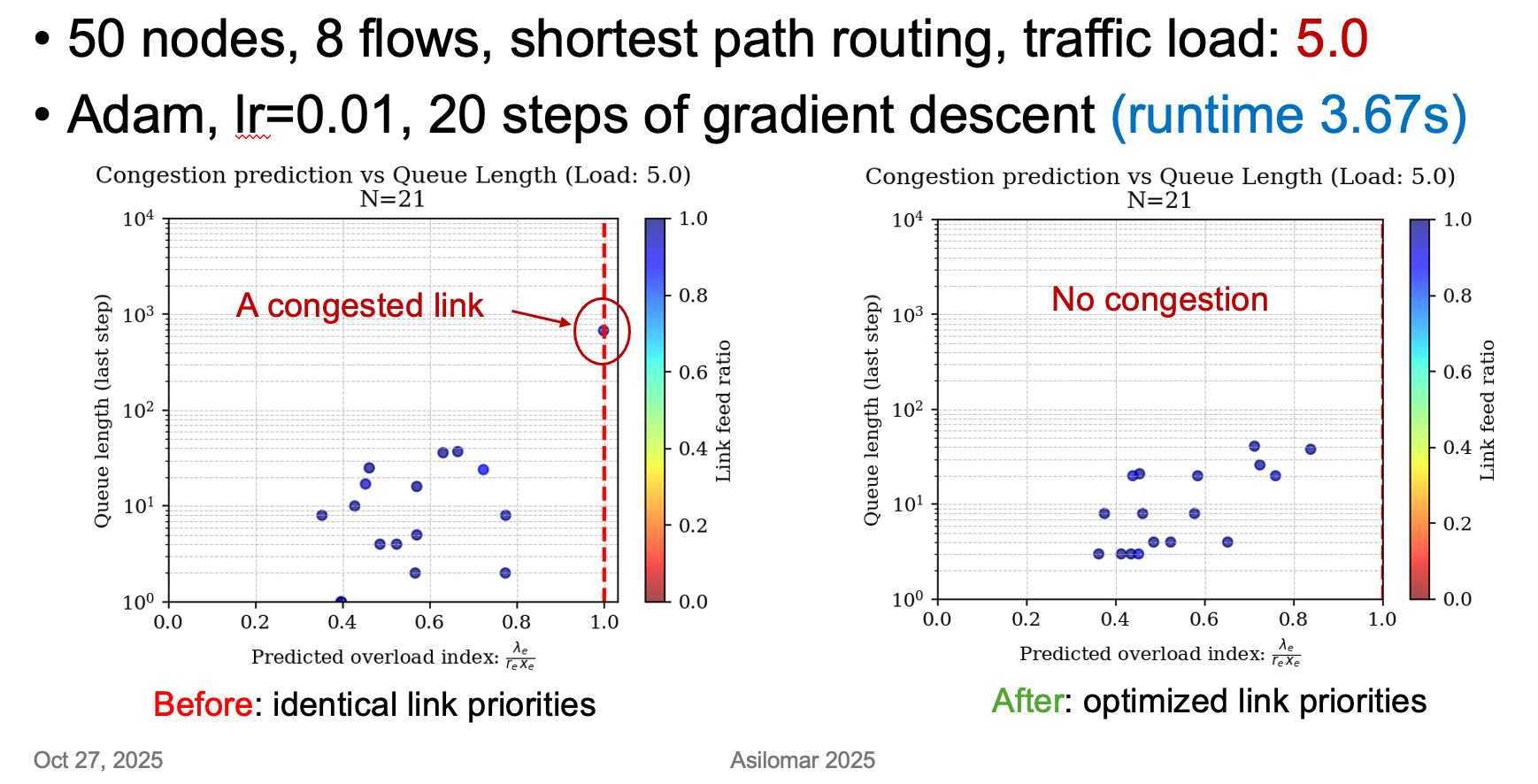
Figure 3. Gradient-based optimization of link scheduling priorities (z in Figure 1, representing the contending aggressiveness policy) mitigates congestion.
This approach provides a scalable analytical foundation for next-generation, self-organizing wireless networks, paving the way for smarter network protocols and new methods of network flow optimization.